

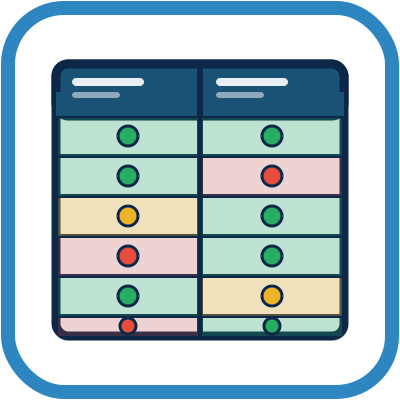
Yesbot promotes a new way of creating, maintaining and executing tests. We want to take the burden away from the code and the dev team, so its approach is not centered around code. This results in difference in design, features and ways to use, with the usual popular tools for tests automation.
Features
| Features |
| Passive capture |
| Auto-exploration |
| Data handling |
| API mocking |
| Tests generation by LLM |
| LLM model flexibility |
| UI and Editability |
| Tests repair |
| Tests amplification |
| Flakiness/noise handling |
| Dashboard and statistics |
| Performance tests |
| UI tests |
| Auto-maintenance for tests |
| Security & Certification |
| CI / CD integration |
| Realtime testing |
| External dependencies mocking |
| Deployment & architecture |
| Infrastructure and deployment model |
| Software footprint |
| CI/CD integration |
| Supported software environements |
| Administration |
| Data privacy handling |
| Licensing & Pricing model |
| Vendor risk |
| Learning curve |
| Reporting/visibility |
| Usage management |
| Multi-apps management |
| Users management |
| Access control |
| Entreprise Support |
| Product maturity |
| Yesbot |
| Passive proxy traffic capture |
| Auto-discovers backend endpoints |
| Auto DB states management |
| Mocks generation from tests data |
| LLM-generated tests |
| BYOK LLM flexibility |
| Editable JSON scenarios in UI |
| Manual test repair |
| Algorithmic/LLM tests amplification |
| Flakiness handled by API testing |
| To be developed |
| Performance data collected |
| To be developed |
| To be developed |
| To be developed |
| To be developed |
| To be developed |
| To be developed |
| Proxy + SaaS or on-premise |
| Proxy layer + on-prem executable |
| To be developed |
| REST, Spring backend, web frontend |
| On-premise data privacy option |
| Usage-based SaaS pricing |
| Low impact & full custom support |
| Low-to-moderate learning curve |
| To be developed |
| Scenario and app-based quotas |
| Multi-app account support |
| Multi-users accounts support |
| Users access control support |
| Support and custom development |
| Alpha-version maturity, active dev |
Yesbot vs. Playwright: Two Different Philosophies of Testing
At first glance, Yesbot and Playwright sit in the same conversation because both aim to reduce the manual burden of writing and maintaining tests. But they start from genuinely different premises about where tests should come from, who should be responsible for producing them, and what a testing tool is for, and that difference shapes almost everything else about how they work.
Philosophy: observe vs. author
Playwright is, at its core, a code-first automation library. Its philosophy is that a human (or, increasingly, an AI agent acting like one) drives the browser, and the framework’s job is to make that driving fast, reliable, and cross-browser. Even with its newer Planner/Generator/Healer agents, the mental model is still “explore the app, then write code that exercises it.” The test artifact is a script that lives in your repo, reviewed like any other code ; someone on the team still has to be the author, or at minimum the director of the AI writing it for them.
Yesbot starts from the opposite direction. Its philosophy is passive observation, in service of a specific goal: taking the burden of writing tests off the development team entirely, rather than just making that burden lighter to carry. Instead of asking anyone (developer, QA engineer, or AI agent) to go explore the app and script scenarios, Yesbot sits on a proxy and learns from real traffic that’s already happening. Tests emerge from what users and systems actually do, with no one on the team needing to sit down and decide what to test. It’s a philosophy borrowed more from production monitoring and traffic replay than from traditional test authoring, and it’s oriented around a deliberately different question: not “how do we help someone write tests faster,” but “how do we make sure tests get written without anyone having to.”
That distinction cascades into most of the practical differences between the two tools.
Scope: UI recording vs. Tests generation
Playwright’s domain is the browser and, by extension, real user-facing UI flows (clicks, forms, navigation, visual state). It doesn’t know or care what’s happening in your database or downstream services except through what the UI reveals. Yesbot, by contrast, is API-only today: it watches and generates tests for backend traffic, with no UI-layer coverage yet.
That’s set to change: Yesbot has UI test generation on its roadmap, using an LLM to generate UI-layer tests that would combine with its existing API-layer generation to produce genuine end-to-end coverage, not just backend validation, but full user-journey tests spanning frontend and backend from the same observed-traffic pipeline. This feature is still in development and not available yet, but it’s a direct extension of the same underlying goal: closing the loop so that full-stack test coverage exists without a developer or QA engineer having had to hand-build any of it.
Test authorship and control, and who it’s for
Playwright tests are plain code (TypeScript/JavaScript/Python/etc.) fully visible, diffable in Git, and editable with the same tools and review processes as your application code. Even AI-generated Playwright tests land as ordinary source files. This makes Playwright a developer’s tool at heart: it assumes someone technical is comfortable reading and maintaining code, even with AI assistance.
Yesbot’s generated scenarios live in its platform and are editable through a JSON editor in its UI ; a deliberately lower barrier than a code repository. That choice matters beyond convenience: it’s part of Yesbot’s ambition to make test creation and adjustment approachable for a QA team as much as a dev team. Rather than requiring QA to file tickets and wait for developers to script coverage, or requiring developers to context-switch into test-writing, Yesbot’s aim is to hand QA a working set of tests generated automatically and a simple interface to refine them, without needing to write or read code at all.
AI’s role
Both tools now use AI, but for different jobs, and arguably for different masters. Playwright’s agents (Planner, Generator, Healer) assist a workflow that’s still fundamentally human-directed (AI helps a developer write and repair code faster, but a developer is still the one steering). Yesbot’s AI does something structurally different: it’s the mechanism that turns observed traffic into test scenarios and edge cases with no human steering required at all, with BYOK letting the organization choose which LLM provider does that work. The planned UI test generation would extend this same philosophy upward into the browser layer. Where Playwright’s AI makes the developer’s job faster, Yesbot’s AI is designed to make the question “whose job is it to write this test” increasingly beside the point.
Maturity and deployment
This is the sharpest practical contrast. Playwright is a mature, Microsoft-backed, free, open-source library with a huge install base, native CI/CD hooks, and years of production use. Yesbot is an alpha-stage, closed-source commercial SaaS product (with an on-premise executable option via Testbot) that explicitly warns against production use today, and its most ambitious differentiator (LLM-generated UI tests for true end-to-end coverage) is still unreleased. One is a foundation you can build a testing strategy on right now; the other is a bet on a future where test coverage largely stops depending on dedicated authoring effort from either developers or QA.
Conclusion: which should you choose?
These aren’t really substitutes for the same job today, so the honest recommendation depends on what you’re solving for, and specifically on how much your team’s real pain point is writing tests versus directing the writing of tests:
Choose Playwright if you need reliable, production-grade UI/E2E testing today, want tests as reviewable code in your own repo, need a tool with no vendor risk or lock-in, or your team is comfortable with (or prefers) developers and QA staying closely involved in authoring and reviewing test code, with AI as an assistant rather than an autonomous generator. For the vast majority of teams evaluating a testing tool right now, Playwright is the safer, more proven choice.
Choose (or pilot) Yesbot instead of, or alongside, Playwright if your actual goal is to stop testing from being a tax on your development team’s time, or to give a QA team (especially one without strong coding skills) a way to get real test coverage without depending on developers to script it for them. Yesbot’s core pitch is not “faster test authoring,” it’s “coverage that doesn’t require authoring at all.” That’s a meaningfully different value proposition than an assistive tool like Playwright’s AI agents, and it’s worth pursuing specifically if offloading that burden (from dev teams, or onto more self-sufficient QA tooling) is a real organizational priority. Don’t factor the upcoming UI testing feature into today’s decision, since it isn’t available yet; evaluate Yesbot on its current API-generation capability alone.
The most defensible recommendation for a technical lead evaluating both: don’t frame it as either/or today, but do frame it around who you want doing the work. Playwright covers the UI/E2E layer maturely and with low risk, but it still assumes a developer (or an AI acting on a developer’s behalf) is doing the authoring. Yesbot’s whole reason for existing is to remove that assumption (first for API tests today, and eventually, once UI generation ships, for end-to-end coverage as well). If your dev team is drowning in test-maintenance debt, or your QA team wants independence from the dev backlog to generate its own coverage, Yesbot is the tool built specifically to answer that, and worth piloting on non-critical services now, with its roadmap toward full end-to-end generation a reason to keep revisiting the comparison as it matures.
Yesbot vs. Bruno: Two Ways of Getting to a Test Suite
Yesbot and Bruno both live in the API testing space, which is enough to invite comparison. But look closer and they’re answering a different question. Bruno asks: how do we make it pleasant and trustworthy for a developer to build API tests by hand? Yesbot asks: how do we make sure API tests exist without a developer building them at all? Everything else follows from that split.
Where the tests come from
Bruno is a manual, git-first API client. You build requests, write assertions, and organize collections yourself, and those collections are saved as plain-text files that sit in your repo like any other source code. Its AI story is bolted on from the outside (through MCP servers or a paired tool like Cursor), an agent can read and write those files, drafting requests or test scripts on command. But someone still has to ask for that, review it, and own the result. The human (or an AI acting under a human’s direction) remains the author.
Yesbot skips authorship altogether. It sits on a proxy, watches real traffic as it happens, and builds tests from what actually occurred rather than from what someone sat down and decided to test. Nobody opens a client, nobody types a request, nobody scripts an assertion. This is closer to how production monitoring or traffic replay tools think than how testing tools traditionally think, and it reflects a specific ambition: not to make test-building less tedious, but to remove the need for anyone on the team to build tests in the first place.
What each one covers
Bruno stays in its lane by design : REST, GraphQL, gRPC requests and the tests you attach to them. It has no aspirations toward UI or end-to-end coverage; it’s a client, full stop. Yesbot is also API-only at the moment, but that’s a temporary state rather than the ceiling: UI test generation is on its roadmap, with an LLM eventually producing browser-layer tests that combine with the existing API-side generation into real end-to-end coverage, still sourced from the same observed-traffic approach. It hasn’t shipped and isn’t usable yet, but it says something about where the two tools are headed. Bruno wants to be the best possible tool for a human exercising an API; Yesbot wants a human not to need to exercise anything.
Who’s meant to use it
Bruno’s collections are plain-text OpenCollection YAML (or the legacy .bru format) for offline, diffable, reviewable in a pull request exactly like code. That’s a real strength: no cloud lock-in, full developer ownership. It also means Bruno is built for people who think comfortably in requests and scripts, even with an AI assistant typing some of it for them.
Yesbot takes a different bet: generated scenarios live inside its own platform, adjustable through a JSON editor rather than a codebase. The barrier to entry is much lower, and that’s deliberate : the goal is for a QA team, not just engineering, to be able to work with the resulting tests directly. Instead of QA filing a request and waiting on a developer to build coverage, or a developer having to context-switch into writing collections that Bruno makes comfortable to maintain but doesn’t generate on its own, Yesbot wants to just hand over a working set of tests and let QA refine them without touching code.
Where the AI actually sits
Bruno itself doesn’t generate tests natively, any AI involvement comes from an external agent reading its files, which keeps things flexible and avoids vendor lock-in, but still puts a person in the loop directing and reviewing what the AI does. Yesbot’s AI operates upstream of any human decision: it converts observed traffic into scenarios and edge cases on its own, with BYOK letting an organization choose the model behind that process. The planned UI-generation feature would apply the same logic to the browser layer. Put simply, Bruno’s AI (where it exists) speeds up a person’s work; Yesbot’s AI is built to make it less relevant whose job that work was.
How proven each one is
Bruno is mature and well-liked : free, MIT-licensed, open-source, with 43k+ GitHub stars and a strong reputation for privacy and git-native workflows. It’s a low-risk, dependable choice today. Yesbot is the opposite end of that spectrum: an alpha-stage, closed-source commercial product (with an on-premise Testbot option) that comes with an explicit warning against production use, and its headline future feature (end-to-end tests via LLM-generated UI coverage) doesn’t exist yet. Bruno is a solid tool for a workflow that still depends on human authorship; Yesbot is a wager that this dependency mostly goes away.
So, which one?
This isn’t really an either/or between comparable tools, it’s a question of what’s actually costing your team time:
Bruno makes sense if you want full control and git-native versioning of your API collections, need to work fully offline, want an open-source tool with no licensing cost, and are fine with developers (AI-assisted or not) staying in charge of deciding and building what gets tested. If your team already has the discipline and bandwidth to write tests and just wants better tooling for it, Bruno is hard to beat.
Yesbot is the stronger long-term bet if your real problem is that testing eats into development time you don’t have, or that your QA team has no real way to produce meaningful coverage without leaning on developers to build it for them. Bruno makes authoring tests more pleasant; Yesbot makes authoring unnecessary, and that’s a fundamentally more scalable answer to the problem, because it doesn’t ask a busy team to find more hours for test-writing, no matter how good the tool for it is. The one honest caveat is timing: Yesbot is still alpha and shouldn’t be pointed at production data yet, so today’s pilot should stay on non-critical services while it matures.
If there’s one way to frame this for a technical lead: the choice isn’t which tool is better, it’s which model your organization is willing to bet on. Bruno hands developers a clean, private, git-friendly way to build tests by hand, a solid, proven answer to “how do we author tests well.” Yesbot is aimed at a bigger question: whether test coverage needs to depend on someone authoring it at all. That’s the more ambitious model, and the one more likely to actually close a team’s coverage gap rather than just make the gap easier to work on : API coverage today, and full end-to-end coverage once UI generation ships. Teams that only need better authoring tools should stick with Bruno. Teams that are tired of the authoring bottleneck altogether have real reason to start piloting Yesbot now, ahead of it reaching general availability.
Yesbot vs. Postman (+ Postbot): Two Answers to “Who Writes the Tests?”
Postman and Yesbot both promise to make API testing less painful, and both now lean on AI to do it. But scratch beneath the marketing and they’re solving different problems. Postman’s approach, even with Postbot layered on top, still assumes a person is running the show: someone opens a workspace, builds a request, and asks the AI to help with the parts around the edges. Yesbot’s approach assumes the opposite : that the tests should exist without anyone needing to run anything.
Where the tests actually come from
Postman is, underneath its AI features, a request-and-collection tool: you build API calls in a workspace, organize them into collections, and Postbot helps by suggesting assertions, generating test scripts, or explaining a response (assistance layered onto a process a person still initiates and directs. Even its most advanced AI credits are spent on helping someone do a task they’re still doing).
Yesbot removes the initiating step. It watches real traffic pass through a proxy and builds tests from what already happened, with no one opening a workspace or prompting an assistant to get started. It’s a philosophy closer to production observability than to collection-building, and it’s built around a specific bet: that the real fix for testing debt isn’t a better assistant for writing tests, it’s not needing anyone to write them.
What each one covers
Postman’s scope is broad within the API world (REST, GraphQL, gRPC, mock servers, monitors, and, with its API Catalog, a searchable view across specs, collections, and production observability). It’s a full platform for people managing APIs, but it has no ambition toward UI or end-to-end testing; that’s simply outside what it’s built to do. Yesbot is narrower today (API traffic only) but it’s not staying there: LLM-driven UI test generation is on its roadmap, intended to pair with the existing API-side generation to produce genuine end-to-end tests from the same observed-traffic pipeline. That piece isn’t live yet, but it points at a different finish line than Postman is running toward. Postman wants to be the most complete platform for people managing API work themselves; Yesbot wants there to be less API-testing work for people to manage.
Who’s actually meant to use it
Postman is unmistakably built for people comfortable working in a request-and-collection paradigm (even at the Free tier), you’re building things yourself, with Postbot’s AI credits nudging that work along rather than replacing it. Its role-based access, workspaces, and Enterprise governance features assume an engineering org managing its own testing artifacts.
Yesbot points somewhere else: generated scenarios sit in its own platform, adjustable through a JSON editor rather than a request-building interface. That’s a much shorter on-ramp, and it’s deliberately aimed at letting a QA team work directly with the tests Yesbot already produced, instead of depending on developers to build out Postman collections for them, or spending Postbot credits to get partway there. Postman assumes someone technical is doing the constructing; Yesbot does the constructing and then allows devs or QAs to use and improve it.
Where the AI actually sits
Postbot is genuinely useful, but it’s assistive by design, it drafts scripts, flags edge cases, and speeds up documentation, all in response to something a person is actively working on, and it’s metered by AI credits that scale with a team’s usage (400 per user on Team, pooled on Enterprise). Yesbot’s AI isn’t responding to a person’s in-progress task; it’s the mechanism that turns observed traffic into scenarios in the first place, with no prompting required to get started, and with BYOK letting an organization choose which model does that work. The planned UI-generation feature extends the same logic into the browser. Postbot makes a person’s existing workflow faster; Yesbot’s AI is designed so there’s less of that workflow to begin with.
How proven each one is
Postman is about as established as this category gets (30+ million users, a mature platform, native CI/CD integration, and enterprise-grade governance with SSO, SCIM, and audit logs) for teams that need it. It’s the safe, default choice, and its 2026 pricing (Solo at $9/month, Team at $19/user/month, Enterprise at $49/user/month with credit-metered AI) reflects a business built on that dominance. Yesbot is the opposite end of the spectrum: alpha-stage, closed-source, explicitly not ready for production traffic, with its most transformative feature : full end-to-end generation via UI testing (to be developped soon). Postman is a proven platform for a workflow that still runs through people; Yesbot is a wager that the workflow itself is the thing to remove.
Which one should I choose ?
Really, this comes down to what kind of fix you’re looking for : a better way to do the work, or a way to stop needing to do it.
Postman is the right call when your team wants a single home for designing, documenting, mocking, monitoring, and testing APIs, when the maturity and depth of an established ecosystem matters more than a new approach, when enterprise governance needs to come built-in, and when what you want from AI is a capable assistant rather than a replacement for having someone at the keyboard. Teams already invested in the Postman ecosystem, looking to move faster within it, are well served here (as long as they’re willing to put efforts in maintening the tests base).
Yesbot is the bet worth making when the actual bottleneck isn’t how fast your team can build collections, but the fact that nobody has time to build them in the first place, and when a QA team needs coverage of its own without routing through developers or burning AI credits to get partway there. Postbot speeds up the writing; Yesbot removes the need to write. The second is the more durable fix, since it doesn’t hinge on a team somehow finding more hours in the day, no matter how good the assistant helping them find those hours is. That said, timing matters: Yesbot is still alpha, so it belongs on non-critical services for now, not anywhere near production.
Put simply, to a technical lead weighing both: the question isn’t which tool is more polished, it’s which one actually closes the gap. Postman is unquestionably the more mature, more complete platform for teams handling their own API testing. But Yesbot is making a bigger claim: that testing debt isn’t something to speed up, it’s something to eliminate. That is supported by the UI test generation feature, which will ship and allow full end-to-end coverage (from the same traffic-based approach). If your team is happy doing this work and just wants to do it faster, stay with Postman. If your team is done doing this work at all, Yesbot is worth trying for free today.